Download App


The economic ties between Russia and the Baltic countries in 2004-2015: the bust, the boom and the sanctions in mutual trade relations
05.11.2015Introduction
Small open economies are related to the high vulnerability to external uncontrollable shocks. Since small economies are highly open to external trade, they are also exposed to developments in the global trade regime, over which they have little if any influence (World Bank 2000, 8). High dependency on one or two external markets makes small open economies particularly vulnerable on the economic turbulences of their trade partners, since these turbulences will be automatically transferred to their own growth prospects. This also applies to the Baltic countries, since they have several times faced serious difficulties related to their economic openness after the restoration of the sovereignty in the beginning of the 1990s. Next to the global economic developments, the challenges for Estonia, Latvia and Lithuania have been often related to Russia’s actions. Mutual economic relations have been particularly tense in the beginning of the 1990s, in 1995–1997, in 2007–2009, when Russia has imposed sanctions against the Baltic countries or has put political or propagandist pressure on them. The current “sanctioning war” is seriously testing the mutual economic relations again and is raising the question whether there is a hope of the “normalization” of trade relations in the nearest future between the Baltic countries and Russia. The motivation for the current research lies in the phenomena that during the past 20 years the entrepreneurs of the Baltic countries have been still interested in developing trade relations with Russia despite the constant setbacks. Thus, the article focuses on the trade dynamics between the Baltic countries and Russia over the period 2004–2015, the main factors that have influences the trade dynamics and the outlook for mutual trade relations to be “normal” again in the light of the current “sanctioning war” between Russia and the EU and its allies.
The bust and the boom: trade between Russia and the Baltic states in 2004–2013
Over the past decade, the trade relations between Russia and the Baltic countries have experienced turbulent times. Due to the close economic ties inherited from the Soviet Union, Russia was the main trade partner for all three Baltic countries shortly after Estonia, Latvia and Lithuania have restored their sovereignty in the beginning of the 1990s. However, in the following years, trade diversion from Russia to the EU member states and associated countries has taken place which is explained by the strengthening of the economic relations with the Western countries, Russia’s high tariffs on the exports from the Baltic countries and constant threats to impose sanctions against them. This concerns particularly imports: in 1991, the Russia’s share in the total imports of Estonia, Latvia and Lithuania reached more than 90%, but in 1994 the share was 21% for Estonia, 29% for Latvia and 46% for Lithuania (Oldberg 2003, 48). Through the 1990s, the three Baltic countries have, to a greater or lesser extent, further reduced the dependency on Russia as an import market. Shortly before the EU-accession of the Baltic countries in 2004, Russia’s share in total imports in Latvia was 8.7% and in Estonia 9.2%. For Lithuania, however, Russia’s share in total imports remained quite significant, reaching almost 23% (author’s calculations based on Compiled statistics... 2015). Russia as an export market was particularly important for Lithuania, where country’s share in total exports reached 9.3% (Ibid.). During the period 1991–2004 trade diversion from Russia to other countries has taken place and already before the EU-accession, the Baltic countries had tight economic contacts with the EU member states and associated countries.
The EU-Enlargement in 2004 affected the economic relations between Russia and the Baltic countries in two ways. On the one hand, European integration provided more stable basis for developing further contacts between the Baltic countries and Russia in the framework of the EU foreign policy, the EU Eastern Partnership and the EU external trade policy. On the other hand, the EU Eastern Enlargement has also deepened some earlier tensions between the neighbouring countries, which were related, for example, to the transit through Lithuania, to the EU-Russia Partnership and Cooperation Agreement established in 1997, and to the energy dependency of the Baltic countries on Russia (DeBardeleben 2009, 45).
This is also reflected in trade dynamics, where “boom” periods were followed by the “busts” and vice versa. The mutual trade has grown during the periods 2004–2008 and 2010–2012 (Figure 1). Shortly after the EU-accession of the Baltic countries, the increase of exports to Russia has been mainly related to the abolition of double tariffs from Russian side. In 2007–2008 and in 2011–2012, the increase in imports from Russia could be, to some extent, associated also with high oil prices. It has been also argued that Russia’s accession to the World Trade Organisation (WTO) in August 2012 has improved opportunities for European exporters to access the Russian market, since subsidies in the Russian agricultural sector were reduced and Russian import duties on agricultural and industrial products were decreased as a result of the accession procedure (Ratso 2015, 1; The Employer’s House 2012, 1). This effect is not so obvious as regards the trade between the Baltic countries and Russia from 2012 on.
The “bust” period in mutual trade relations occurred during the global economic crisis in 2009. As the author sees it, next to the impact of the global economic crisis also Russia’s trade restrictions and import bans to the products from the Baltic countries should be taken into account. For example, in 2009 Russia imposed stricter border controls in Russia’s border with the Baltic countries (Mauricas 2015a, 2), in 2012 banned imports of live animals from Estonia and introduced partial sanctions on Estonian fishery and dairy products (Statistics... 92014, 1), in the end of 2013 banned all dairy imports from Lithuania (Mauricas 2015a, 2.
At the same time, also the impact of Russia’s attempts to politically destabilize the Baltic countries and violent actions in Georgia in 2008 should not be underestimated, when discussing the sources of the setback in trade relations in 2009. Hereby the author refers to the following events: the so-called Estonian Bronze Soldier monument crisis and the call by the Russian Federation Council to cease diplomatic relations with Estonia in April 2007 accompanied with large-scale cyber-attacks against Estonian state institutions, the blockade of the Estonian embassy in Moscow in May 2007 by the Russian youth movements, the boycott calls by Russian officials against Estonian products in Summer 2007, the blocking of the truck traffic at the main bridge into Estonia and the cut-off of the delivery of oil, coal and petroleum products to Estonia in May 2007 (Roth 2009, 13). Although some authors have argued that political tensions in Estonia in 2007 have led to the reduction of transit but not the Estonia’s exports to Russia (Kitsing 2015, 1), the author of the current article believes that given the historical background, the Baltic countries are still cautious as regards the risks related to Russia’s political ambitions to increase its sphere of influence in the former Soviet Union republics. This statement is also confirmed by relevant statistics indicating that trade between Estonia and Russia declined remarkably after events in spring 2007, based on the monthly data.

Figure 1: Trade between Russia and Estonia, Latvia and Lithuania in 2004-2014
Source: Complied statistics... 2015a.
Trade balance with Russia has been negative over the entire 10-years period in Lithuania and during most of the period in Latvia, as could be seen from Figure 1. Remarkably, although in Estonia the total external trade was been in constant deficit during the whole period, trade with Russia is in surplus already since 2008 (see Statistical Office... 2015). The country’s trade surplus with Russia is mainly associated with the growth in the exports of machinery and electrical equipment and products of chemical or allied industries and with the cyclical developments in the imports of mineral products and fuels from Russia.

Figure 2: Russia’s share of total exports and imports of Baltic States in the period 2004-2014
Source: Compiled statistics... 2015a
To conclude, Russia is important trade partner particularly for Lithuania. At its peak over the past decade, Lithuania’s imports from Russia accounted for 30% of total imports, and exports to Russia accounted for 20% of country’s total exports (see Figure 2). Russia’s share in foreign trade of Estonia and Latvia is lower, varying from 6 to 11% of total foreign trade. In this light it would be reasonable to assume that Lithuania will be most vulnerable among the Baltic countries to the political and economic instability stemming from Russia.
The “sanctioning war” in 2014-2015: implications for the Baltic countries
Political tensions between Russia and Ukraine in 2013 have culminated in the violation of territorial integrity of Ukraine in March 2014 and military conflicts in the eastern part of Ukraine forced by Russia from 2014 on. To resolve the conflict, in March 2014 the EU and its partners have decided to impose travel bans and asset freezes against Russian and Ukrainian officials involved in Russia’s annexation of Crimea and to cancel the EU-Russia summit. The scope of individuals and entities subject to the Western sanctions has been gradually widened in April, May and July 2014. Russia responded with retaliatory sanctions against high-ranked officials of the EU, USA and Canada in March 2014. In July 2014, the EU announced sector-specific sanctions against the Russian military industry and financial and energy sector, which restricted country’s access to international capital markets and placed an embargo on trade of arms and sector-related technologies. As a countermeasure, in August 2014, the Russian President Vladimir Putin signed a decree which mandated the one-year embargo on the large number of agricultural products from the Western countries. The ordinance of the Russian government which specified the banned items (such as fruits, vegetables, meat, fish, milk and dairy products, etc.) has been adopted and published with immediate effect. In September 2014, the leaders of the EU and the US have agreed on additional sanctions, forbidding state-controlled Russian oil and defence companies from raising money in European capital markets and cutting off foreign investments. Further additions to the list of persons, organizations and companies under sanctions have been made in November 2014. In response to this, Russia continued to restrict trade with the West. In June 2015, the EU Council extended economic sanctions against Russia until the end of January 2016. Russia responded with additional sanctions and with additional legal and economic measures to integrate Crimea into Russia. In July 2015, both the leaders of the European Union and the US have agreed on additional sector-specific sanctions against Russia. According to the current plans, from the EU side sanctions against Russia are valid until January 2016 and the Russian sanctions against the EU countries and their allies are valid until August 2016.
Hereby, leaving aside the more fundamental question whether sanctions could be considered as a realistic measure to find a solution to the conflict in Ukraine, a more specific question remains how much have the Russian sanctions against the EU member states affected the economies of the Baltic countries and what are the prospects for the “normalization” of mutual economic relations in the future?
In general terms, the impact of the Russian sanctions on the EU growth prospects has been estimated to be rather limited. According to the estimation of the European Commission, the sanctions will decrease the EU’s economic growth by 0.3 to 0.4% age points in 2014 and 2015 and the negative effect is caused by the lower demand for imports from European countries and from Russia’s countersanctions. The effect of asset freezes and visa bans is considered as rather secondary (Bond et al. 2015, 11). According to Vanden Houte (2014, 1), one could expect the European economy to grow by one% additionally in 2015, if the sanctions have not been imposed. The direct impact of sanctions would be relatively minuscule, as the GDP growth would be lower by about half of a tenth of a percentage point. Havlik (2014, 6–7) states that in terms of trade exposure, machinery, transport equipment and electrical equipment are the most important export branches exposed to Russia in the EU, whereas food products which are banned by Russia do not feature prominently among the EU exports to Russia, but are extremely important to some EU countries, such as the Baltic States.
However, several EU countries have already reported that they have difficulties due to the Russian sanctions and have demanded to take actions to compensate their losses. For example, the Netherlands has estimated that country’s losses could be tripled in comparison to the initial estimates, and France has asked the European Commission to take measures to deal with the fallout from a Russian ban on food imports from Europe. At the same time, compared with other EU member states, the Baltic countries are mostly affected by the Russian sanctions according to the estimations. For example, Mauricas (2015a, 1) has stated that an overall direct effect of Russian sanctions on the economic growth in the whole Baltic region amounts to 0.6% of GDP, but, as expected, Lithuania has suffered the most from the “sanctioning war”. The direct effect of Russian sanctions on economic growth amounts to 0.81% of GDP in Lithuania, 0.46% in Estonia and 0.44% in Latvia. Accordingly, macroeconomic impact of sanctions is highest for Lithuania, Estonia and Latvia.

Figure 3: Trade between Russia and Baltic States in 2004Q1-2015Q2 (dark line denotes the dynamics of exports and light line denotes the dynamics of imports)
Source: Compiled statistics... 2015.
As can be seen from Figure 3, the Russian sanctions have mostly affected exporters in Lithuania, Latvia and Estonia, and in all three countries the major slump in exports has taken place in the first quarter of 2015. The fall in exports has been particularly sharp as regards the exports of dairy products. According to Mauricas (2015b, 1), the overall export of dairy products fell by 23% in Lithuania, 32% in Latvia and 36% in Estonia during from August 2014 to April 2015 due to the sanctions. However, the decline in exports to Russia has been partially compensated by the growth in exports to other regions.
Russian sanctions have seriously damaged some economic sectors in the Baltic countries, such as food and agricultural sector, and have mostly affected exporters in Lithuania, Latvia and Estonia. The overall effect of sanctions on the economies of the Baltic countries has not been remarkable, ranging from 0.4 to 0.8% of the country’s GDP. However, small open economies that have high shares of foreign trade to the GDP are very vulnerable to the risks related to the turbulences in foreign markets. Thus, next to the trade dynamics between the Baltic countries and Russia, in the long run also secondary effects should be taken into account when discussing the impact of Russian sanctions on the economies of the Baltic countries. Since the “sanctioning war” affects also specific sectors of the main trade partners of the Baltic countries, such as Finland, Germany, Poland and the Netherlands, the negative effects for the Baltic countries could be higher than estimated earlier.
Prospects for the “normalization” of mutual trade relations in the future
In the light of the current “sanctioning war” between the EU and Russia, it is appropriate to ask what would be the outlook for trade relations between the Baltic countries and Russia being “normal” again in the future. However, the author admits that the subsequent discussion on the future prospects of the trade relations between the Baltic countries and Russia is to a large extent hypothetical, and the author is open for further discussions on this issue.
Mutual trade relations are, on the one hand, directly related to the sanctions which are currently valid from the EU side until January 2016 and from Russian side until August 2016. Under these circumstances, it would be irrational to expect that particularly Russia’s import from the Baltic countries would increase, at least, in the short term. On a wider scale, also the “stigmatisation” of Russia in the international arena due to the violation of the principle of sovereignty of Ukraine speaks against the deepening of trade relations. Also the impact of the instability stemming from Russia’s earlier attempts to use trade policy as a tool to put pressure on its neighbour countries should not be underestimated.
On the other hand, mutual trade relations have been in decline on more than one occasion over the past 20 years which raises the question why the entrepreneurs of the Baltic countries are despite constant setbacks still interested in developing trade relations with Russia? As the author sees it, the main motivation for the Estonian, Latvian and Lithuanian enterprises to develop trade relations with Russia is related to the size and the proximity of the Russian market, since large-scale market offers the entrepreneurs better opportunities to win from the economies-of-scale effect and to maximize the profits. Also, comparing the data from the latest economic recession in the Baltic countries, in Russia and in the EU (on the average basis), Russia has faced more serious economic recession than the EU on the average, but despite its structural weaknesses, Russian economy recovered from the recession faster than the EU (on the average basis) and the Baltic countries (see Figure 4).
However, in the light of the Russia’s recent actions such as the irrational “sanctioning war”, country’s geopolitical ambitions in the region, jailing of the entrepreneurs and oligarchs in Russia, demonstrative destruction of food products originated from the Western countries and constant economic and political pressure on its neighbour countries, the entrepreneurs of the Baltic countries should, more than ever, take into account that Russian market is highly insecure. Today, the current situation offers rather little hope of the “normalization” of trade relations between the Baltic countries and Russia in the nearest future. However, what could be really challenging for the Baltic countries is the more fundamental shift in the export structure. More precisely, the re-orientation of the Baltic entrepreneurs from Russian market to other markets should go hand in hand with the concentration on products with higher added value. The importance of the diversification of risks has been stressed also by several experts
For example, Ratso (2015, 1) has stressed that concentration on products with higher added value makes it is easier to find markets for these products and to earn more profits (see Ratso 2015, 1). The author agrees to this suggestion, particularly in the context that, for example, in Estonia approximately one third of the exporters are exporting their products to only one foreign market, and half of them are exporting to one or two markets abroad (ERR 2012). The orientation on the products with higher added value would enable them to diversify the risks and to focus on several foreign markets. In a longer term, this would enable them to limit the losses stemming from the trade relations with Russia.

Figure 4: The real GDP growth compared to the economic peak in Baltic States, Russia and in the EU (on the average basis); quarterly data
Note: The peak of the economic cycle is noted as t0. The period from t1 to t23 refers to the 6-years period after the economic peak. In Estonia, the economic peak was in the 4th quarter of 2007, in Latvia in the 3rd quarter of 2007, in Lithuania and in Russia in the 2nd quarter of 2008.
Source: author’s calculations based on IFS (2015).
Conclusions
The present article focused on the trade dynamics between the Baltic countries and Russia over the period 2004–2015, the main factors that have influences the mutual trade and the outlook for mutual trade relations to be “normal” again in the light of the “sanctioning war” between Russia and the EU. The research has been motivated by the phenomena that during the past 20 years the entrepreneurs of the Baltic countries have been still interested in developing trade relations with Russia despite the constant setbacks.
Over the past decade, both “boom” and “bust” periods occurred in the trade relations between the Baltic countries and Russia. The mutual trade has grown in 2004–2008 and 2010–2012, mainly because of the abolition of double tariffs from Russian side in 2004, and the high level of oil prices in 2007–2008 and in 2011–2012. Also more stable basis for developing further contacts between the Baltic countries and Russia in the framework of the EU foreign policy, the EU Eastern Partnership and the EU external trade policy has been developed after the EU-Enlargement. The “bust” period in mutual trade relations occurred during the global economic crisis in 2009. However, next to the impact of the global economic crisis also Russia’s direct trade restrictions and import bans to the products from the Baltic countries and the attempts to destabilise the Baltic countries and other former Soviet Union republics politically in 2007 – 2008 have harmed mutual trade relations. The current “sanctioning war” between the EU and Russia is again seriously testing the economic relations between Russia and the Baltic countries, since Russian sanctions have seriously damaged some economic sectors in the Baltic countries and affected their exports to Russia.
The current economic situation offers rather little hope of the “normalization” of trade relations between the Baltic countries and Russia in the nearest future, since the mutual sanctions are valid from the EU side until January 2016 and from Russian side until August 2016. Although the potential of the Russia as an export and import market should not be underestimated, the entrepreneurs of the Baltic countries should, more than ever, take into account that Russian market is highly insecure. Even more challenging task for the Baltic countries is related to the need for the fundamental shift in the export structure. More precisely, the re-orientation of the Baltic entrepreneurs from Russian market to other markets should go hand in hand with the concentration on products with higher added value. The orientation on the products with higher added value would enable them to diversify the risks and to focus on several foreign markets. In a longer term, this would enable them to limit the losses stemming from the trade relations with Russia.
About Riga
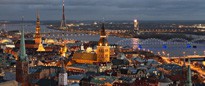
Founded in 1201, Riga offers its visitors a vast historical heritage and modern dynamism that is unparalleled.
 READ MORE
Contact Us

Ms. Katrīna Allikas
Contact person for speakers, official delegations & general issues
- [email protected]
- (+371) 22572285
- View Map