Download App

Agenda
For two days, dozens of distinguished leaders and experts will be presenting their opinions on the most touching issues in foreign policy and defence of the Baltic Sea region and beyond.
Programme
- Day 1October 11, 2019
- Day 2October 12, 2019
- 12:40 - 13:40REGISTRATION
- 13:40 - 13:45WELCOMING REMARKSWelcoming Remarks by Mr Toms Baumanis, Chairman of the Board, Latvian Transatlantic Organisation
- 13:45 - 14:15OPENING REMARKSOpening Remarks by H.E. Mr Krišjānis Kariņš, Prime Minister of the Republic of Latvia
- 14:15 - 15:45OPENING SESSION: CAN THE EU REFORM ITSELF?
Following European elections, the political landscape has become even more fragmented than before. Will the recently elected European Parliament and new European Commission use the opportunity to reform and reinvigorate the European Union after BREXIT? In the past, the EU proved effective in overcoming destructive unilateralism in international affairs. Today European institutions are sound, but nationalistic tendencies seem to be growing among Europeans. Unilateralism poses a risk to European integrity, including its international standing as a unified political actor. How can the EU overcome risks posed by unilateralism both internally and externally?
H.E. Mr Edgars Rinkēvičs, Minister of Foreign Affairs of Latvia
H.E. Mr Linas Linkevičius, Minister of Foreign Affairs of Lithuania
Sir Malcolm Rifkind, former British Foreign Minister and former Minister of Defence
Ms Martina Larkin, Head of Regional Strategies, Europe and Eurasia, Member of the Executive Committee, World Economic Forum
Moderator: Dr Žaneta Ozoliņa, Vice Chairman of Latvian Transatlantic Organisation, Professor of the Department of Political Science, University of Latvia
- 15:45 - 16:15COFFEE BREAK: NATO – ON THE WAY TO A NEW IDENTITYWith fluctuations within the transatlantic relationship, many have gotten to wonder about the unity of the greatest alliance in the world and what kind of stake it holds in the digital era. The panel will discuss the current actions and trends within NATO and how a new approach to security will be formed in the future.
Mr Alexander Vershbow, Former Deputy Secretary General, NATO
Moderator: Prof Dr Julian Lindley - French, Senior Fellow, Institute for Statecraft, London; Director, Europa Analytica, Netherlands; Distinguished Visiting Research Fellow, National Defense University, Washington DC; Fellow, Canadian Global Affairs Institute; Chair & Founder of The Alphen Group - 16:15 - 17:45PLENARY SESSION: COMPREHENSIVE & COLLECTIVE – BUILDING THE FOUNDATION OF NATO’S FUTURE DEFENCE
For 70 years, NATO has successfully adapted to changing political landscapes to maintain peace for its members. As the number of vulnerable domains increases, the Alliance’s collective defence must adapt once more. For decades comprehensive defence has been seen as a strategy for non-aligned countries. Soon this will no longer be the case. How will the comprehensive defence efforts of several allies strengthen the Alliance? How can a comprehensive strategy best complement the collective approach?
Ms Annegret Kramp-Karrenbauer, Federal Minister of Defence of the Federal Republic of Germany
Dr Artis Pabriks, Deputy Prime Minister and Minister of Defence of the Republic of Latvia,
Mr Peter Hultqvist, Minister for Defence of the Kingdom of the Sweden
Moderator: Dr Christian Mölling, Deputy Director, DGAP’s Research Institute
- 17:45 - 18:15COFFEE BREAK: THE ROLE OF HUMAN RIGHTS IN A DIGITAL SOCIETYDay to day lives of the current society have become ever efficient as a large portion of individuals have easy access to a private assistant as well as guide and direct route to friends and family in our pockets through the medium of phones and in our bags through computers. However, the society has become a data enrichment facility through the utilization of these services and with that said service providers are given the possibility to use this data for economic gain. Requiring for us to take a few steps back and look at the possible uses of data within authoritarian regimes as well as democracies and what are the current and possible breaches of human rights by both state and non-state actors impeding upon the rights of the few and the many.
Ms Anna Vladimirova-Krjukova, Associate, Certified Data Protection Officer, COBALT
Moderator: Ms Lolita Bērziņa, Constitutional court of the Republic of Latvia - 18:15 - 19:45PLENARY SESSION: NEW POWERS - SHAPING REGIONS OR SHAPING HISTORY?
The economic strength of population giants like China and India is steadily increasing. Other countries like Brazil, Russia, or the Gulf states also have growing regional economic and political interests. Some, but not all, of these counties have accepted democratic norms. Some of these nations have never been as powerful as they are today. The Russians and Chinese are successfully utilizing economic resources by buying up economic assets in target regions or neighbouring countries. Is it still appropriate to speak of these rising powers as shaping their regions of influence? Or are these new powers shaping history on a much larger scale now?
Dr Simon Serfaty, The Zbigniew Brzezinski chair (emeritus) in Global Security and Geopolitics at the Center for Strategic & International Studies and Professor and Eminent Scholar at the Old Dominion University
Ms Anna Wieslander, Director for Northern Europe, Atlantic Council
Mr Brian Whitmore, Senior Fellow and Director of the Russia Program, Center for European Policy Analysis
Moderator: Mr Julian Röpcke, Political Editor, BILD
- 19:45 - 21:15OPENING DINNER, VENUE - NATIONAL LIBRARY OF LATVIA
- 21:15 - 22:45NIGHT OWL SESSION: BUILDING THE WAY FORWARD - UKRAINE AND GEORGIA
Session is held under the "Chatham House Rule"
The Black Sea region has become a geopolitical battleground that poses growing difficulties for Georgian and Ukrainian foreign and security policy choices. What is the best way forward for Georgia and Ukraine? Can policy grow out of the status quo or does a Georgian-Ukrainian alliance need to form? During the last few decades Eastern Europeans developed a strong belief in the concept of "Europe Whole and Free". It implies that only EU and NATO membership can provide a viable future for Ukraine and Georgia.
Ms Ketevan Tsikhelashvili The State Minister for Reconciliation and Civic Equality of Georgia
Dr Hanna Hopko, former Head of the Committee on Foreign Affairs, Parliament of Ukraine
Amb. John Herbst ,Director of the Dinu Patriciu Eurasia Center, Atlantic Council
Mr Jerzy Pomianowski, Executive Director, European Endowment for Democracy
Moderator: Ms Orysia Lutsevych ,Research Fellow and Manager, Ukraine Forum, Russia and Eurasia Programme, Chatham House - 21:15 - 22:45NIGHT OWL SESSION: RACE FOR THE ARCTIC: ENVIRONMENTAL CONCERNS, ECONOMIC OPPORTUNITIES AND SECURITY IMPLICATIONS
Session is held under the "Chatham House Rule"
For a long time, the Arctic had been perceived as a distant corner of the world, isolated by forces of nature. Extreme climate, permanent ice cover, large distances, and limited infrastructure were the primary reasons for a lack of human imagination and endeavour to make the region more beneficial for the common good. But with the transformation of the region due to climate change these days have gone. Today the Arctic is not only important to the members of the Arctic Council. The region attracts more and more close and distant non-Arctic players. Do they see a potential for new transportation and infrastructure routes? What risks, but perhaps even more importantly, what opportunities for neighbouring regions, can we expect due to the growing interest and competition among different stakeholders? Is the Arctic a new geopolitical playground for natural resources? What are the opportunities and security implications for countries in the Baltic Sea region?
H.E. Kevin Rex, Ambassador of Canada to Latvia, Estonia and Lithuania
Amb. Jānis Eichmanis, former Latvian Ambassador to NATO
Dr Benedetta Berti, Head, Policy Planning Office of the Secretary General NATO
Mr Niklas Granholm, Deputy Director of Studies, Swedish Defence Research Agency
Moderator: Dr Mika Aaltola, Programme Director of the Global Security Research Programme, Finnish Institute of Foreign Affairs
- 21:15 - 22:45NIGHT OWL SESSION: EU STRATEGIC AUTONOMY VS EU STRATEGIC RESPONSIBILITY?
Session is held under the "Chatham House Rule"
“Strategic autonomy: yes! But to do what exactly? To protect ourselves, or to protect others, outside Europe, as well? To protect ourselves by defeating the enemy on his own ground, in Europe’s neighbourhood or further afield? Or only by making sure he doesn’t breach the walls of Europe? To protect us from all enemies, or only from some? Who is the “enemy” anyway?”1
Indeed, can we, at least in Europe, define what EU strategic autonomy means? Is there are common understanding of the concept? Between piles of documents or the development of serious capabilities; what do defence budget increases mean? How and what are we going to implement? This panel discusses how changes to European defence policy will impact defence and security both in individual member states and the CSDP more generally.
Mr Jānis Karlsbergs, Undersecretary of State, Policy Director, Ministry of Defence of the Republic of Latvia
LtGen (ret.) Heinrich Brauss, Senior Associate Fellow, German Council on Foreign Relations
Mr Michael Gonzalez, Senior Fellow, The Heritage Foundation
Mr Olivier Landour, Director for Europe, North America and Multilateral Affairs, Ministry of Defence of the French Republic
Moderator: Prof Dr Julian Lindley-French, Senior Fellow, Institute for Statecraft, London; Director, Europa Analytica, Netherlands; Distinguished Visiting Research Fellow, National Defense University, Washington DC; Fellow, Canadian Global Affairs Institute; Chair & Founder of The Alphen Group
1 Quote from the Egmont Paper 103, Fighting for Europe, European Strategic Autonomy and Use of Force, author Prof Dr Sven Biscop
- 21:15 - 22:45NIGHT OWL SESSION: CHINA’S GROWING INTERNATIONAL INFLUENCE
Session is held under the "Chatham House Rule"
China’s current leadership has designed a governmental model directed toward establishing the country as a powerful and influential global player. China is neither copying the Soviet nor Western model of development in order to exercise its growing power. The goal of “becoming a modern socialist country” ranks high on the agenda of its Two Centenary Goals, with trans-continental, financial, people-to-people, and digital connectivity as some of the main means to achieve international outreach. What can we expect?
Dr Li Xing, Professor and Director, Research Center on Development and International Relations
Dr Tosh Minohara, Professor of Japanese Diplomacy, Graduate School of Law and Politics, Kobe University
Dr Kerry Brown, Director of the Lau China Institute, King's College London
Moderator: Ms Tara Varma, Head of the Paris Office and Policy Fellow, European Council on Foreign Relations
Tweets about us
#RigaConf19 Tweets- Dear participants, we are incredibly thankful that you chose to be a part of The RC 2019! Sincere thank you goes to… https://t.co/rakUfz1EZN17.10.2019 (11:16)
- The Rīga Conference 2019 is officially over! We are truly thankful to our speakers, participants, partners, staff m… https://t.co/qFTsIG2AmU12.10.2019 (19:26)
- We are approaching the end of Day 2 with concluding remarks by the Foreign Affairs Minister of the Republic of Latv… https://t.co/5aWiKQKEYD12.10.2019 (18:09)
- #RigaConf19 Concluding Session " CONVERSATION WITH THE PRESIDENT OF THE REPUBLIC OF LATVIA H.E. MR EGILS LEVITS "… https://t.co/9v66tof6Jn12.10.2019 (17:15)
- Witty quote by Mr John Frank on the Digital Age panel: "How do you know when a politician is lying? When their lips are moving." #RigaConf1912.10.2019 (15:24)
- Technology and how we use it is a very topical matter nowadays. Tune in live on https://t.co/SV53bNeMH9 for the pan… https://t.co/rfGoSPnbWL12.10.2019 (14:52)
- Tune in for the second day of the Riga conference debates at https://t.co/BG96g4yC69 #RigaConf19 https://t.co/flB8aub43R12.10.2019 (13:10)
- And we're done with the first session on Russia and the West. Great discussions, questions and reminders about the… https://t.co/9e3HAgrhpg12.10.2019 (11:39)
- The Rīga Conference 2019 Day 2! Make sure to join us on livestream at https://t.co/SV53bNeMH9 and use #RigaConf19 f… https://t.co/DStGNJrIR512.10.2019 (10:12)
- Day 2 #RigaConf19 will start with RUSSIA AND THE WEST MANAGING CRISES Moderated by Ms Jill Dougherty @jillrussia12.10.2019 (09:56)
- The Rīga Conference 2019 day one has been a success! Opening by H. E. the Prime Minister of Latvia, 3 great panels… https://t.co/yVOj8Z8Jzk11.10.2019 (22:25)
- The next Plenary Session at the #RigaConf19 is on the topic: NEW POWERS - SHAPING REGIONS OR SHAPING HISTORY? Join… https://t.co/RqkZOYgKyC11.10.2019 (18:23)
- Plenary session "New Powers - Shaping Regions or Shaping History?" is about to start! Moderated by Mr Julian Ropcke… https://t.co/ZusCUEPweU11.10.2019 (18:16)
- "Nowadays everybody's a writer and just a few of them are readers." - Dr Artis Pabriks @Pabriks #RigaConf1911.10.2019 (17:01)
- The Plenary session "Comprehensive & Collective - Building the Foundation of NATO's Future Defence" has started! Mo… https://t.co/ibPoqT2PyU11.10.2019 (16:47)
- #Russia is not a superpower but it is a superproblem - @LinkeviciusL at #RigaConf19 https://t.co/v0fTGrdV8h11.10.2019 (15:42)
- Lithuanian FM @LinkeviciusL at #RigaConf19 ‘Russia is not a superpower, it is a super problem’ https://t.co/up08epQCFy11.10.2019 (15:41)
- Lithuanian FM @LinkeviciusL at #RigaConf19 on Steinmeier Formula - no agreement in Donbas should come at expense… https://t.co/kXXdm6Jtl111.10.2019 (15:39)
- When we think about our security in today's changing world, we have to consider military, cyber, informational thre… https://t.co/r1eYrac5cO11.10.2019 (15:37)
- Latvian FM @edgarsrinkevics at #RigaConf19 Before we even consider lifting sanctions Russia must withdraw from Do… https://t.co/mDgQ8hYksG11.10.2019 (15:34)


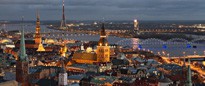
About Riga
Founded in 1201, Riga offers its visitors a vast historical heritage and modern dynamism that is unparalleled.
 READ MORE
Contact Us

Ms Sabīne Štāla
Contact Person for Speakers, Security & General Issues
- [email protected]
- (+371) 25638336

Mr Jēkabs Baumanis
Contact Person for Participants & Accommodation
- [email protected]
- (+371) 22018088

Ms Laura Krastiņa
Contact Person for Media
- [email protected]
- (+371) 29250441