Download App


Day 2 (September 29th)
- 09:30 - 10:00MORNING COFFEE
- 10:00 - 11:30THE WORLD ACCORDING TO RUSSIANS
Most Russians consider Joseph Stalin the “most outstanding person” in world history, surpassing even President Vladimir Putin who ranks second according to a Levada Center public opinion poll. The poll also suggested that famous Russians like Pushkin, Tolstoy, Gagarin or Mendeleev are considered less influential than these political leaders. Is it really the majority of Russians who believe this? In our analyses there is a tendency to conflate Putin’s Russia and Russia itself, the state and society, the political regime and its people. What ideology and values do Russian citizens believe in? Do their views overlap or contradict with those of political and business elites? How do Russians perceive the world? And why should the rest of the world care?
Mr Vladimir Kara-Murza , Russian Opposition PoliticianMr Mikhail Fishman , Commentator at TV Rain, RussiaMr Andrei Kolesnikov , Senior Fellow and the Chair of the Russian Domestic Politics and Political Institutions Program at the Carnegie Moscow Center, RussiaDr. Vladislav Inozemtsev, Director, Centre for Post-Industrial Studies, RussiaModerator: Mr Artemy Troitsky , Journalist, Russia - 11:30 - 12:00COFFEE BREAK: RAIL BALTICA – WHAT IT OFFERS TO THE SECURITY IN THE REGION?Rail Baltica is probably the most complex and investment-demanding transportation project undertaken by Lithuania, Latvia and Estonia. While very few would argue the necessity of integrated transportation system with the rest of the Europe, what does this project offer for the security of the region?
Mr Aivar Jaeski , Rail Baltic Estonia OÜ, Estonia Branch DirectorModerator: Dr. Sandis Šrāders, Board member of Latvian Transatlantic Organisation, Director of Sales and Strategic Projects at Radio of Latvia - 12:00 - 13:30GERMANY AT THE CENTRE OF A CHANGING EUROPE
American political retreat, the UK’s decision to leave the EU, and persisting European disunity have pushed Germany to take a leading role in the European Union. French president Emanuel Macron has an ambition to reform the Union. This can be done only by aligning the EU members, including Germany. A French-German motor has frequently been the driving force behind reform plans in the past. What role is Germany willing to play now? What are other European countries expecting from Germany given its strong economic position in the heart of Europe?
Dr. Daniela Schwarzer , Director, German Council on Foreign Relations, GermanyDr. Artis Pabriks , Member of European ParliamentMr Steven J. Erlanger , Bureau Chief for The New York Times, BelgiumMs Elisabeth Bauer , Head of the KAS Office for the Baltic States and Nordic CountriesModerator: Mr Peter Sparding, Transatlantic Fellow, Europe Program, German Marshall Fund of the United States - 13:30 - 15:00LUNCH BREAK: ARCTIC
The Arctic is experiencing a profound moment of transformation. Climate change has set a stage for the region to become an integral part of global affairs. It comes with both, great deal of opportunities, but with challenges as well. We have a promise of a positive economic benefit, but it should be sustainable and not endangering global climate. Today we see a genuine cooperation among the Arctic nations, but there are no clear cut international borders that will determine maritime, corporate and security patterns of the region. We have a common existential interest to protect the Arctic environment from deterioration, but processes perhaps are much deeper than ones associated with a human activity. In this very diverse mosaic of interests are we able to find a consensus on how to secure a change in the Arctic that is sustainable and friendly?
Amb. Andris Razāns , Ambassador – Director of the Policy Planning, Ministry of Foreign Affairs, LatviaMr Niklas Granholm , Deputy Head of Studies, Swedish Defence Research Agency, SwedenMs Elisabeth Bauer , Head of the Konrad Adenauer Foundation Office for the Baltic States and Nordic Countries, GermanyModerator: Amb. Jānis Eichmanis , former Ambassador to Permanent Representation to NATO of the Republic of Latvia - 15:00 - 16:30CHALLENGES IN THE BALTIC SEA REGION
For more than two decades The Baltic Sea Region was an example of the successful removal of mental and physical borders and the creation of cooperative networks among communities, businesses, and states. Since 2014 the region has been challenged by geopolitical shifts, fragmentation tendencies, and increased military activities. What is the image of the Baltic Sea Region in these turbulent times? How is the region perceived from the European and Transatlantic perspectives? Which countries are ”in-siders” and which are “out-siders” of the region? What role can regional organizations play in balancing diverse interests of the stakeholders? Can the Baltic Sea Region expand beyond its geographical borders, embracing countries interested in closer cooperation with regional players?
Dr. Zanda Kalniņa – Lukaševica , Parliamentary Secretary of the Ministry of Foreign Affairs, LatviaAmb. Ms Maira Mora , Director General of the Council of the Baltic Sea States SecretariatDr. Pavel K. Baev , Research Professor at the Peace Research Institute Oslo (PRIO), NorwayAmb. Philip Reeker, U.S. European Command Civilian Deputy and Political AdvisorDr. Kęstutis Paulauskas , Staff Officer at Defence Policy and Planning Division, NATOModerator: Dr. Žaneta Ozoliņa , Vice Chairman of Latvian Transatlantic Organisation, Professor of the Department of Political Science, University of Latvia - 16:30 - 17:00COFFEE BREAK: CAN EU KEEP UP WITH THE WORLD PACE
While former global leaders are pushed to the second row, the European Union is facing its own tectonic power shifts. While dealing with Brexit, drafting of the next multiannual budget and dealing with other issues on the agenda, can the EU keep its place in the world power thermometer and still be as competitive as ever?
Dr. Daniela Schwarzer , Director, German Council on Foreign Relations, GermanyDr. Balkan Devlen , Associate Professor at University of Copenhagen, DenmarkModerator: Mr Vlad Vernygora , Lecturer at the Tallinn University of Technology, Estonia - 17:00 - 18:30DETERRENCE BY RESILIENCE – ARE DEMOCRACIES PROACTIVE ENOUGH IN PROTECTING WESTERN VALUES?
Russia is investing heavily in developing its military capabilities. At the same time, Kremlin-sponsored campaigns are trying to influence and undermine democratic processes by exploiting vulnerabilities of Western democratic societies. How can democracies respond to these challenges and protect themselves without sacrificing values of freedom of speech and expression? Do Western societies believe strongly enough in their value system and are they willing to protect it? How should democratic governments balance military and non-military means to ensure deterrence by resilience?
Mr Jānis Garisons, State Secretary, Ministry of Defence of LatviaThe Rt Hon Earl Howe, Minister of State for Defence, United KingdomMr Juri Luik , Minister of Defense of the Republic of EstoniaDr. Michael Waller , Vice President, Center for Security Policy, United StatesModerator: Prof. Dr Julian Lindley-French , Senior Fellow, Institute for Statecraft, London; Director of Europa Analytica, Netherlands; Distinguished Visiting Research Fellow at National Defense University, Washington DC and Fellow at Canadian Global Affairs InstituteConcluding remarks: Mr Raimonds Bergmanis, Minister of Defence of the Republic of Latvia - 19:00 - 21:00GALA RECEPTIONHosted by Ms Elisabeth Bauer, Head of the KAS Office for the Baltic States and Nordic Countries.
Sign up for your broadcast reminder
Tweets about us
#RigaConf18 Tweets- We would like to say a big thank you to our supporter @AudiLatvija for their continued support. In this year's conf… https://t.co/v3SWs6b11009.10.2018 (16:51)
- At #RigaConf18, I urged NATO allies to "map out and exploit the vulnerabilities" of Putin's inner circle, the Russi… https://t.co/FF2X8plkXV04.10.2018 (01:01)
- NATO doesn't have an effective deterrence or retaliatory capability against Moscow for cyber attacks. So at… https://t.co/IWn2ie8eUD02.10.2018 (17:06)
- Did you have chance to see @LATO_LV #RigaConf18 and discussion with @aivarj, RB Rail AS? If not, then watch the dis… https://t.co/pTMAGjKgOW02.10.2018 (16:15)
- Did you had change to see @LATO_LV #RigaConf18 and discussion with @aivarj, RB Rail AS? If not, then watch the disc… https://t.co/ysuIT4Vaso02.10.2018 (15:12)
- Governments and the media should have an understanding on what is #FakeNews. It is a matter of responsability and t… https://t.co/sx1tZyLzW801.10.2018 (16:51)
- Thanks to the #RigaConf18 team in @LATO_LV for a great conference once again. It was a pleasure to talk with Vlad V… https://t.co/3nS15ABTcW01.10.2018 (15:23)
- Is there a life after another successful "The Riga Conference"? The good news are that we are left w/ this brillian… https://t.co/7E78Dk3b4j01.10.2018 (12:41)
- Also on way back from #latvia #RigaConf18. Not for first time think Jeremy hunt should have stayed at health https://t.co/L88mV9WyNM30.09.2018 (19:38)
- Indeed, also Vladislav Inozemtsev argues according to the same lines ... https://t.co/nVoyDgdj2e #RigaConf18 https://t.co/odOeHrdMn430.09.2018 (18:09)
- Latvian parliamentary secretary @ZKLukasevica at #RigaConf18: Russia’s systematic efforts of challenging the rules-… https://t.co/d6DvYt9XCi30.09.2018 (11:31)
- #RigaConf18 Last night of the conference. Thank you for a great and well organised event from the Swedish MFA and t… https://t.co/aLLIvx30bM29.09.2018 (21:55)
- #RigaConf18 ended in an all-male fashion that dominated the discussions for the whole two days. It’s great we have… https://t.co/RH9zX3nCcZ29.09.2018 (21:14)
- PALDIES @LATO_LV @AizsardzibasMin @Arlietas un atbalstītājiem par kārtējo izcilo #RigaConf18! Thank you for another… https://t.co/Dd4zZZUerH29.09.2018 (20:45)
- Thanks to our speakers, our participants, and you - our online audience! You’ve made this the best #RigaConf18 ever… https://t.co/UZEu1nkbsC29.09.2018 (18:39)
- Concluding #RigaConf18 @RaimondsBrg thanks everyone for coming to Rīga on the eve of its 100th birthday, urging tha… https://t.co/5Bsj0A6uPr29.09.2018 (18:37)
- In the UK, we don’t have conscription, we concentrate on professionalism of the army. We need to be resilient psych… https://t.co/ScXWhq2FI329.09.2018 (18:17)
- 'Governments and the media should have an understanding on what is #FakeNews. It is a matter of responsability and… https://t.co/z9NXltFp4V29.09.2018 (18:09)
- #RigaConf18 Basic question: what exactly are Western values?29.09.2018 (18:05)
- Governments and media need to reach common understanding of what misinformation and fake news are, - The Rt Hon Ear… https://t.co/qBv23NVs4029.09.2018 (18:05)


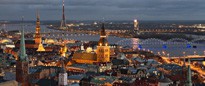
About Riga
Founded in 1201, Riga offers its visitors a vast historical heritage and modern dynamism that is unparalleled.
 READ MORE
Contact Us

Ms Sabīne Štāla
Contact person for speakers, partners, security & general issues
- [email protected]
- (+371) 25638336

Ms Elīne Dembska
Media coordinator
- [email protected]
- (+371) 26834171