
The truth is what you make of it: The challenges of the post-factual era
12.10.2016The Russian response to the release by the Dutch-led joint investigation team, on 28 September 2016, of yet a report naming Russian-supported East Ukrainian separatists as responsible for the downing in July 2014 of the Malysian Airlines flight MH17 demonstrates the current and future challenges of interacting with that state in the global information space. As expected, the Russian authorities rejected all findings, citing Western bias and ulterior motives, and instead presented yet an interpretation of what could have happened on that fateful day in July 2014. This time, the Russian Ministry of Defence presented new radar images alleged to show that no BUK missile system was in place in separatist-held Eastern Ukraine and that logically the missile had therefore had to have been launched from government-controlled territory.
This is by now a well-known pattern. The Russian regime, supported by state-controlled media, have rejected all accusations that East Ukrainian separatists were involved in the shoot-down of MH17, and it has denied any involvement in the supply of military equipment to the separatists, in this case the BUK missile system. According to the European Union East Stratcom Task Force, by September 2016 the Russian state-controlled media had offered a staggering total of nine alternative scenarios to explain what now seems quite clear to objective observers: That the BUK missile system entered Eastern Ukraine from Russia; that it was handled by separatists, who also fired the missile at MH17; and that it was then quickly on-loaded onto a truck and whisked across the border back into Russia.
The basic tenet of the Russian disinformation strategy is the claim that all news is constructed and therefore contested. In the best postmodern tradition there is no “objective news” – only different rivalling interpretations which purport to show different aspects of what may be called “reality”. And what the Russian media outlets present are merely possible explanations which serve as alternatives to the stories offered by Western media. It is a strategy which is both cunning and elegant as it preys on the enlightenment tradition and on the vulnerabilities of liberal democratic media. Few researchers working in the social sciences would dare to make the claim that what they offer is “true” in any definitive sense and this has view has sifted through to the media which is keen to offer alternative perspectives and to let readers, listeners and viewers decide for themselves what to believe. It is the post-factual era and it is the exercise of extreme perspectivism.
The state-controlled Russian media serve as an unprecedented force multiplier. Unable or unwilling to do the job which they are supposed to do – which includes watching carefully over the executive and legislative branches – they have become a tool in a wider Russian strategy. An oft-used term is “the weaponisation of information” which, while perhaps a bit dramatic, alerts us to the fact that the media is incorporated into Russian political thinking not as a constraint but as an asset to be used in the pursuit of all sorts of goals, ranging from the tactical (“Ukrainian forces today violated the ceasefire at village X”) to the strategic (“the West is seeking to weaken Russia”). This campaign represents the state-of-the-art in its well-polished design and well-executed implementation but also, so it seems, in its level of aggression and cynicism. Liberal democracies should prepare themselves for a future which will see even more contested news arenas with even more constructed news.
Even by Russian standards there seems to have been a paradigm shift in the instrumental use of the media to further particular interests. Compare for instance the handling of MH17 to the downing by the Soviet Air Force in 1983 of Korean Airlines flight KAL007. While initially the Soviet Union denied any involvement in the incident, the regime soon changed track and allowed news reports in the state-controlled media to explain to the Soviet public that their military commanders had actually given the order to shoot down a civilian airliner. The current Russian regime clearly is unable to perform a similar step with respect to the BUK missile which hit MH17 and the Russian media not only let it get away with this but even transmit the counter-narratives designed to cause confusion in the post-modern and perspectivist news space.
A cognitive change seems needed in order to fully grasp the implications of the paradigm shift – that (non-democratic) states will go to greater extremes than seen in decades to manipulate public opinion in target states. The protective shield is often referred to as a “cognitive firewall”. It allows the free flow of information, including from Russian state-controlled media, but it also establishes a cognitive filter which prevents the disinformation from striking root and being internalised by members of the target audience. This clearly is a tall order, but liberal democracies are better prepared to achieve this than any other type of state and it may of course be done.
The cognitive firewall should be installed at both the collective and at the individual level. We should improve our ability at the society-wide level to recognise and subsequently reject disinformation and not give it the attention which it demands. And at the individual level we should develop a new media literacy; a new ideal of Bildung is required which gives member of the target audience the tools with which to distinguish the facts from the faction and the information from the disinformation.
Ideally this Bildung would be established taught at school (where it would be comparable to for instance science or computer literacy) and the media of the target states may support this by educating its audiences and by exposing biased and manipulative reporting. Several dedicated units now exist at the international level (also at NATO which supports for instance the Strategic Communications Centre of Excellence) to expose for instance Russian disinformation and it is relatively easy for the media to plug into this. In the post-factual era the more vulnerable actors need to assess their defenses in the cognitive domain and to adjust if needed. It is high time.
Tweets about us
#RigaConf TweetsAbout Riga
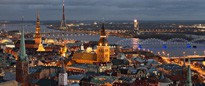
Founded in 1201, Riga offers its visitors a vast historical heritage and modern dynamism that is unparalleled.
 READ MORE
Contact Us

Ms Sabīne Štāla
Contact person for logistics, security & general issues
- [email protected]
- (+371) 25638336
- View Map