
East Flank of NATO
10.10.2016First of all, it should be emphasized that no diplomatic efforts and attempts to "pacify" the Russian aggressor have any slightest historical and logical rational grounds.
One must also leave behind any hope that a change of the key man, or even the ruling group in Russia (the so-called "apical coup") will lead to a decline in tensions in Eastern Europe and the former Soviet Union.
The strategic objectives and political priorities of the latter have not changed at all: the Kremlin still continues to dream of nuclear parity with the United States and European countries, and about the area of exceptional political, economic and military influence Dnepr to Elbe, as it was in the days of the CMEA and the Warsaw Pact. It is enough to read and listen without prejudice to the speeches of leading Russian politicians, including the most senior officials, as well as experts on their service, to have any remaining doubt go away.
The Warsaw summit has shown that the western part of Europe is only coming to realize what has long been said by the presidents of Lithuania and Estonia, the defense and foreign ministers of Poland, representatives of the political class of Ukraine, not to mention experts, including Russian ones, one of whom I humbly consider the author of these lines.
It remains to be hoped that the process of mental, political and military consolidation of the West - all that we call the civilized world - will happen fast enough within the framework of the Alliance, and Russia will not be able to cease the initiative, let alone develop it. A large and, one can say, landmark step in this direction would be an understanding that NATO has no eastern or southern flanks as separate, unrelated areas of international and military policy of the Alliance.
One of the main methods of the Russian imperial foreign policy is terrorism and provocations. Russia, at least since its invasion of Syria, has in fact been waging such a provocative terror war against the Western world it hates.
We all know about the information war, the concept of the "global Russian world" and an unprecedented expansion of the Russian information space. We are also well aware of the methods of nuclear and energy blackmail, the first of which is widely used today, while the second was used in the recent past. Now it is clear to every unbiased observer that we are talking about terrorist blackmail. Experts have repeatedly pointed out, for example, the fact that Iraqi, Libyan and Syrian officers fighting within Islamic State's "terrorist" troops are mostly graduates of Russian/Soviet military schools, there are many Russian citizens among the ranks of Islamic soldiers, including with newly-minted foreign passports. This says a lot to people familiar with the practice of "volunteers", "holiday-makers", "humanitarian convoy", not to mention the PMCs (private military companies).
Strangely, by automatically taking responsibility for all terrorist acts committed in European countries, Islamic State puts forward no demand, which would be customary for terrorists. However, every terrorist act is accompanied by Moscow's increasingly more clear and rigidly sounding demands to join it in a union against global terrorism. It is obvious that the Kremlin is thus trying to overcome its international isolation, make everyone reckon it among leading global geopolitical players and blow the sanctions regime, which suffocates its economy.
We should not forget about another principle of legal tradition "cui prodest"? Almost all terrorist acts matched the interests, geopolitical schedule and the pace of the Kremlin's international life. Russian does carpet bombing using prohibited weapons, kills a lot of civilians whose only possible guilt is that they are dissatisfied with the regime of B.Assad, destroys the democratic opposition left, right and centre, and finally admits that it is at war with Islamic State, but attacks for some reason take place on the territory of countries which are not fighting Islamic State directly, but which, to their detriment, accept a huge number of refugees, and which, unlike Russia, show tolerance to the completely alien Muslim religious and national minorities yet.
Terrorist acts do not occur in those EU and NATO countries which periodically and at least in some form raise the issue of reconciliation with Russia, the need to take its interests into account and lift sanctions. However strikes are delivered against the main EU countries, participants in the Normandy format on the implementation of the Minsk agreements and against the city where the EU and NATO headquarters are located.
These are the same countries which by "a strange coincidence" have become the main target of the invasion of millions of refugees. Until recently Islamic State refrained from comments about Russia, let along holding terrorist acts on its territory. I think the key to overcoming the terrorist threat as well as to solving the problem of refugees, not to mention infinite attempts to destabilize the civilized world order, is in Moscow.
In other words, strategically, NATO has no eastern flank, there is confrontation between the Alliance, guarding the civilized world, democracy and world order, and Russia, constantly encroaching on this civilization and this order. I think that now or in the very near future the overwhelming majority of the Western political class and expert community not bribed by the Kremlin and the expert community fill find it obvious: when the "Russian threat" is liquidated, the majority of terrorist organizations will curtail their operations, refugee will thin out significantly and become more manageable and less aggressive.
Tweets about us
#RigaConf TweetsAbout Riga
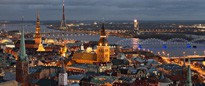
Founded in 1201, Riga offers its visitors a vast historical heritage and modern dynamism that is unparalleled.
 READ MORE
Contact Us

Ms Sabīne Štāla
Contact person for logistics, security & general issues
- [email protected]
- (+371) 25638336
- View Map